Third Interview I did not get the chance to do the third interview because my interviewee left the date we suppose to do the recording. Interview preparation The preparations I made for my third interview were very similar to my first and second interview. My objectives were the same; I wanted to still look and, somewhat create a comfortable environment for my interviewee and me. A day before the actual interview date, we enjoy a calm easy flowing conversation with my interviewee about the process. I gave her the interview question paper, which I usually do with the same questions. I felt I had picked out top questions because I wanted to learn more from my interviewee. I believed my last two interviews went flawless; I did most everything else the same. It worked well; with the third one, I want it to be special and that I am thankfully, I had gotten all my questions and the place ready. We agreed to meet up Wednesday in Atwood missippi room at 6 pm. I waited for 30 minute and she haven’t showed up yet, then I texted her if she is on her way to the place, where we suppose to meet? I got the text that said she could not make it because she found a ride to her hometown North Dakota. so she want to take the chance to be there with her family for thanks giving. I could not reply anything than saying “have a good trip and happy thanks giving.” Country report Liberia “Liberia lies on the west coast of Africa. The name comes from the English word "liberty" and refers to the nation's origin as a colony of free blacks repatriated to Africa from the United States in the early nineteenth century.”(2) Geography “Area: 111,369 sq. km. (43,000 sq. mi.). Slightly larger than Ohio.Cities: Capital--Monrovia (pop. 1,010,970). Principal towns--Ganta (pop. 41,000), Buchanan (pop. 34,000), Gbarnga (pop. 34,000), Kakata (pop. 33,000), Voinjama (pop. 26,000).”(1) Government “Type: Republic. Independence: July 26, 1847 (from American Colonization Society). Constitution: January 6, 1986. Branches: Executive--president. Legislative--bicameral. Judicial--Supreme Court, courts of first instance, courts of record, justices of the peace. Political parties: 20 registered political parties in 2005.”(3) ECONOMY Liberia was traditionally noted for its academic institutions, iron-mining, and rubber. Political upheavals beginning in the 1980s and a 14-year civil war (1989-2003) largely destroyed Liberia's economy and brought a steep decline in living standards. The Liberian economy relied heavily on the mining of iron ore and on the export of natural rubber prior to the civil war. Liberia was a major exporter of iron ore on the world market.(1) PEOPLE There are 16 ethnic groups that make up Liberia's indigenous population. The Kpelle in central and western Liberia is the largest ethnic group. Americo-Liberians who are descendants of freed slaves that arrived in Liberia after 1820 make up less than 5% of the population.(2) HISTORY Liberia, "land of the free," was founded by free African-Americans and freed slaves from the United States in 1820. An initial group of 86 immigrants, who came to be called Americo-Liberians, established a settlement in Christopolis (now Monrovia, named after U.S. President James Monroe) on February 6, 1820.(1) U.S.-LIBERIA RELATIONS “Congress appropriated $100,000 in 1819 for the establishment of Liberia (and resettlement of freemen and freed slaves from North America) by the American Colonization Society, led by prominent Americans such as Francis Scott Key, George Washington's nephew Bushrod, Henry Clay, Daniel Webster, and Presidents Monroe (for whom Liberian settlers named the capital, Monrovia), Adams, and Jackson. The first group of settlers arrived in Liberia from the United States in the 1820s. The United States, which officially recognized Liberia in 1862, shared particularly close relations with Liberia during the Cold War.”(4) LIBERIAN DANCE  Music and dance are an integral part of village life in Liberia. The people dance and sing for the departed souls of the dead, at celebrations and weddings, on behalf of important visitors, and just for fun. Liberian dances are often noted for the energy and passion displayed by the dancers. ![A child performs during a celebration in Monrovia, Liberia, January 16, 2007. [© AP Images]](https://lh3.googleusercontent.com/blogger_img_proxy/AEn0k_tS1_kGBtz0ZD-TKW98RyTGjIITJ1oYv0qwW0O-5U2HC5pE67BrjXRclg_WDcC6MR0Oij40WEq0qcySGqHkrwxBe50bVOH4dOVf-WLdRqPvn0lmYhXYOnYQyaXpwLNk=s0-d) Bodeor” combines live music, dance, and theatre to depict the shifting times and challenges of the African people. It is performed in uniform, in order to comment on the political turmoil that characterizes much of contemporary African society. Work cited 1-Liberia:History,Geograghy,Government,andCulture http://www.infoplease.com/ipa/A0107718.himl#ixzzlbqUWfDgD 2-Liberia:U.S. State Dept.Country Notes,Liberia:Information Please: http://www.infoplease.com/country/profiles/liberia.html 3-Liberia:History,Geograghy,Government,andCulture http://www.infoplease.com/ipa/A0107718.himl#ixzzlbqUWfDgD 4-Liberia:U.S. State Dept.Country Notes,Liberia:Information Please: http://www.infoplease.com/country/profiles/liberia.html |
Thursday, December 1, 2011

Thursday, November 17, 2011
Thursday, November 10, 2011
Interview Transcription
B- Berekti E: Ernest
B: What is your name?
E: My name is Ernest Cholopray
B: Ernest, where are you from?
E: Liberia, Monrovia
B: Oh, you live in the capital?
E: Yes.i moved to Monrovia when I was eight.
B: How old where you when you graduate high school?
E: eighteen.
B: Please describe the education system of your country.
E: We have to go through elementary, high school and university. About 98% of the senior high schools are in Monrovia and the others within the rural areas of the country. In the senior high school level, students are prepared for universities, and learned the second editions to subjects taught during the years of junior high. Students are also allowed to sit for the West African Exams if they are successful. The main higher education institutions in Liberia are the University of Liberia and Cuttington University.
B: Did you attend college in Liberia?
E: No, I came after my senior high.
B: Who influenced you to choose United States school?
E: My best friend who I grow up with mentioned to me to try applying for scholarship here. And after a year I end up getting what I want. Here I am.
B: Wow interesting, I am glad you are finally here.
E: Thank you very much.
B: After coming to USA, What culture changes you found amazing?
E: The social life. You have a lot of privacy here. It is more about doing you own thing and your needs, which are, very different from Liberia.
B: What is the form of government in your country?
E: Liberia has an independent with a republican form of government
B: Tell me one thing, which makes you proud of your country?
E: Liberia never been colonized by any country. Every I think about it, makes me happy. Ethiopia has the same kind of story, right?
B: you are right! Ethiopia and Liberia are the only Africa countries that never been colonized.
E: I will get to interview you one day so that I will get to know about Ethiopia.
B: Ofcourse. I will be honored.
B: What places /sites would you recommend to tourists?
E: Roberts’s port best known for its untouched beaches also southeast of Monrovia is Buchanan. South of town are the beaches that are best to have a good time.
B: What festivals do you celebrate in your country?
E: In Liberia Christmas, New Year, and Independence Day, These holidays, we celebrated as national holidays throughout Liberia.
B: What is the weather like in your hometown?
E: Liberia has two primary seasons. The dry season, starts from November to March, and the rainy season, starts from April to October.
B: What is a type of sport in your country?
E: Soccer
B: What is a traditional food in your country?
E: Dumboy and Foo-foo made from cassava and served with Palm Butter.Yummy.you should try it.
B: I will be happy if you will invite me for cookout.
E: Ofcourse.I will
B: I really had fun with you. Thank you for your time.
Actually, after we done with the recording, the time was around 5 pm and he asked me if I have anything to do. My response was, I am planning to find food, and then he offered me to cook Liberian food, so he went for grocery shopping. Until his back, I waited him cooking rice. Around 7:45 pm, I ate Liberian food for the first time. It was a little spicy for me but I ate it all. It was the best experience.
Preparation for the interview
We were bowling with my Friends from work and I had a team consisting of five girls and one person. The teams were to be only five people total and you must have one member of the opposite sex. We noticed the other team that had four people but no girl. So we offered up one of ours to them. This league only had six teams so we bowled what we dubbed the "guy team" often. I asked this guy where is he from, his from Ghana. Since I was looking for librarian person, I asked him if he have Liberian friend. He has one but his not here then I offered if he wanted to meet on Saturday for my class interview. He held back the laughter and said yes! After two days, we meet, and explained to him how the interview is all about. Once I know he agreed with it was time to go for recording.
Describe the interview
In this interview, like the last interview, I was surprised to know about Liberia more. What makes my first interview with Alfereda different from Ernest; he is more motivating to keep the interview interesting with his sociability. He did not have much different answer than the student from the first interview. He was happy to answer all of my questions, and he enjoyed the interview because after our interview, he keep bringing p that this was his first time to be interviewed by anyone, and it made him feel like celebrity. He was so hilarious.
I was happy that he had some of the same experiences as me, because I am also an international student. The other thing I get to know about him was that how hard worker and strong personality he has. He works thirty hours a week being full time student. I had a lot of interesting conversation I shared got from him that could be role model for other international students who think they are alone.
Liberia Country Report

Liberia is a country in West Africa. It is bordered by Sierra Leone, Guinea Republic and Côte d’Ivoire and the Atlantic Ocean. “As of the 2008 Census, the West African country is home to 3,476,608 people. It occupies 111,369 sq km.Liberia is Africa’s oldest republic but also one of its poorest nations. It is struggling to get back on its feet after almost 14-years of civil war, which led to the deaths of 250,000 people. The capital city is Monrovia.”(2)
Liberia has a hot climate with most rainfall coming in the summer, winds in the dry season with little variation in temperature. Dry wind blows from December to March, making the coastal belt particularly and the other wet season comes between May and October.
“Africa's first republic, Liberia was founded in 1822 because of the efforts of the American Colonization Society to settle freed American slaves in West Africa”(1). A private organization that believed ex-slaves would have greater freedom and equality in Africa. Even though, emigration of blacks to Africa was an answer to the problem of slavery and the incompatibility of the races Slaves freed from slave ships were also sent there instead of being repatriated to their countries of origin. “Over the course of forty years, about 12,000 slaves were voluntarily relocated. Originally called Monrovia, the colony became the Free and Independent Republic of Liberia in 1847.”(1)
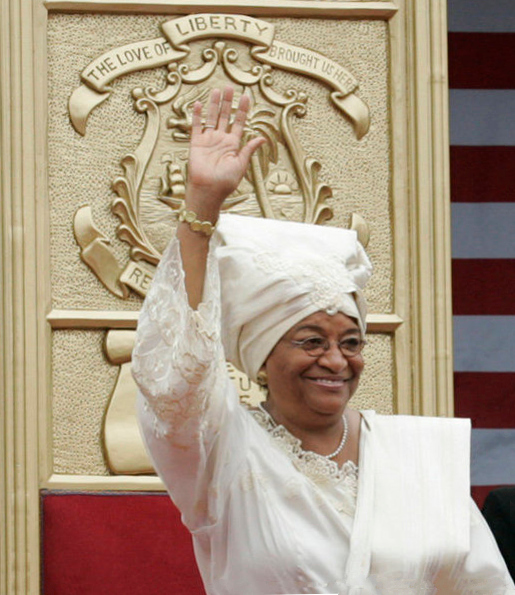
President Ellen Johnson Sirleaf
“The government of Liberia, modeled on the government of the United States, is a unitary constitutional republic and representative democracy as established by the constitution. The government has three co-equal branches of government: executive, headed by the president; legislative, consisting of the bicameral Legislature of Liberia; and judicial, made up of the Supreme Court Supreme and several lower courts. The president serves as head if government, head of state and the commander-in –chief of the Armed Forces of Liberia.” (3)
“The English speaking Americo-Liberians, descendants of former American slaves, make up only 5% of the population, but have historically dominated the intellectual and ruling class.”(1) Liberia's population is composed of 16 different ethnic groups and its government of Africa's first republic was sculptural after that of the United States.
Work cited
1-Liberia:History,Geograghy,Government,andCulture http://www.infoplease.com/ipa/A0107718.himl#ixzzlbqUWfDgD
2-Liberia:U.S. State Dept.Country Notes,Liberia:Information Please:
http://www.infoplease.com/country/profiles/liberia.html
3-^ a b c d e f g h i "Liberia". The World Factbook. Central Intelligence Agency. 2011. https://www.cia.gov/library/publications/the-world-factbook/geos/li.html. Retrieved July 20, 2011.
Berekti Girmay
What is global communication essay
Global communication is the collective processes that are developed and used to create and improve communication on a worldwide level. Global communication brought about many effects. On the one hand, it is blurring economic, political, and cultural boundaries.
Economically, separate industries that had developed around each of these technologies are combining to service the new multimedia environment through a series of corporate mergers and alliances. Politically, global communication is undermining the traditional boundaries and sovereignties of nations. Direct Broadcast Satellite is violating national borders by broadcasting foreign news, entertainment, educational, and advertising programs with impunity. Similarly, the micro-media of global communication are narrow casting their messages through audio and videocassette recorders, fax machines, computer disks and networks, including the Internet and the World Wide Web. Culturally, the new patterns of global communication are creating a new global Coca-Colonized pop culture of commodity fetishism supported by global advertising and the entertainment industry.
On the other hand, global communication is empowering hitherto forgotten groups and voices in the international community. Its channels have thus become the arena for contestation of new economic, political, and cultural boundaries. Global communication, particularly in its interactive forms, has created immense new moral spaces for exploring new communities of affinity rather than vicinity. It is thus challenging the traditional top-down economic, political, and cultural systems.
Global communication seems to have at once its discontents. Surrounding them has confronted each other in, political, economic, and cultural encounters. In this context, global communication channels can serve the cause of world peace and reconciliation only if they can be turned into channels of international and inter-civilization dialogue.
Work cited
Anderson, Benedict. 1983. Imagined Communities: Reflections on the Origins and Spread of Nationalism, rev. ed. London: Verso.
Brandt, Willy et al. 1980. North-South: A Program for Survival. London: Pan Books.
Brandt, Willy et al. 1985. Common Crisis: North-South Cooperation for World Recovery. Cambridge, MA: MIT Press.
Branscomb, Anne Wells. 1994. Who Owns Information-: From Privacy to Public Access. New York: Basic Books.
Cohen, Eliot A. 1996. "A Revolution in Warfare," Foreign Affairs, March/April: 37-54.
Commission on Global Governance. 1995. Our Global Neighborhood. New York: Oxford University Press.
Global communication outline
What is global communication and how has it promoted the globalization witnessed in the past ten years?
Introduction
What is global communication?
Global communication is the collective processes that are developed and used to create and improve communication on a worldwide level. Global communication brought about many effects. On the one hand, it is blurring economic, political, and cultural boundaries.
Body
I. Economically
i. Industries that had developed around each of these technologies
ii. The new multimedia environment through a series of corporate mergers and alliances
II. Politically
i.Undermining the traditional boundaries, and sovereignties of nations.
ii. Direct Broadcast Satellite violating national borders by broadcasting foreign news, entertainment, educational, and advertising programs with impunity
iii. The micro-media of global communication narrow casting their messages through audio and videocassette recorders, fax machines, computer disks and networks
III. Culturally
i.The new patterns of global communication are creating a new global Coca-Colonized pop culture
ii. Intercultural communication supported by global advertising and the entertainment industry.
Conclusion
Global communication seems to have at once its discontents. Surrounding them has confronted each other in, political, economic, and cultural encounters. In this context, global communication channels can serve the cause of world peace and reconciliation only if they can be turned into channels of international and inter-civilization dialogue.
Sunday, November 6, 2011
Thursday, November 3, 2011
Subscribe to:
Posts (Atom)